
A Novel Anti-Tissue Factor Pathway Inhibitor Antibody, BAY 1093884, Restores Hemostasis in Induced Hemophilia A Rabbits With Reduced Thrombogenic Potential

A Novel Anti-Tissue Factor Pathway Inhibitor Antibody, BAY 1093884, Restores Hemostasis in Induced Hemophilia A Rabbits With Reduced Thrombogenic Potential

Year: 2015
Grants:
Bleeding Disorders Conference
Biomedical/Coagulation Research
Author(s):
Maria Koellnberger, Axel Trabandt, Derek Sim, Volker Laux

Background:

BAY 1093884 is a fully human monoclonal antibody against tissue factor pathway inhibitor developed as a bypass agent for hemophilia patients with inhibitors. It restores thrombin burst, leading to stable clot formation in hemophilic conditions in vitro and effectively stops bleeding in vivo.

Aims:

Efficacy and thrombogenic potential of BAY 1093884 were evaluated in bleeding models in acquired hemophilia A rabbits and the Wessler venous stasis model, respectively.

Methods:

The efficacy of BAY 1093884 was tested in rabbit bleeding models. Anti-factor VIII antibodies rendered rabbits hemophilic, increasing bleeding time by ~3-fold (median 120–390 seconds) in an ear bleeding model and >7-fold (median 240–1800 seconds) in a saphenous vein bleeding model. In the Wessler model, thrombosis was induced by complete ligation of the jugular vein after administration of BAY 1093884, recombinant FVIIa (rFVIIa), or activated prothrombin complex concentrate (aPCC) to measure in vivo hypercoagulability.

Results:

In both bleeding models, BAY 1093884 corrected bleeding time close to normal in a dose-dependent manner. A statistically significant reduction in saphenous vein bleeding was reached at 1 and 3 mg/kg BAY 1093884, reducing bleeding time to 330 and 240 seconds, respectively. In contrast, 1 mg/kg rFVIIa only slightly reduced bleeding time to a median of 1200 seconds. In the Wessler model, 1 mg/kg rFVIIa and 40 IU/kg aPCC resulted in thrombus formation, reaching full occlusion in rabbits with normal coagulation system. In contrast, BAY 1093884 up to 100 mg/kg did not fully occlude, and only showed a slight increase in localized clot formation over baseline, which could be completely prevented by an anticoagulant. In addition, no stasis-triggered thrombi were seen in hemophilia A rabbits treated with BAY 1093884, indicating reduced thrombogenicity risk for BAY 1093884 in patients with hemophilia.

Conclusions:

These studies showed that BAY 1093884 potently controls bleeding in hemophilic rabbits while showing reduced thrombogenic risk compared with the current standard of care.


Prevalence of high BMI in school age children with hemophilia

Prevalence of high BMI in school age children with hemophilia

Year: 2015
Grants:
Bleeding Disorders Conference
Quality of Life/Outcomes Research
Author(s):
Ellen White, Alice J Cohen, Melinda Inzani
Impact of FVIII CRM-positive status on the immunogenicity of FVIII in the hemophilia A mouse model

Impact of FVIII CRM-positive status on the immunogenicity of FVIII in the hemophilia A mouse model

Year: 2015
Grants:
Bleeding Disorders Conference
Biomedical/Coagulation Research
Author(s):
Jasmine Ito, Rylee Mercer, Brittany Chao, Michael Lenardo, John Healey, Hunter Baldwin, Shannon Meeks
An Evaluation of the Switch from Standard Factor VIII Prophylaxis to Prophylaxis with an Extended Half-Life, Pegylated, Full-length Recombinant Factor VIII (BAX 855)

An Evaluation of the Switch from Standard Factor VIII Prophylaxis to Prophylaxis with an Extended Half-Life, Pegylated, Full-length Recombinant Factor VIII (BAX 855)

AWARDED/PRESENTED: 2015
GRANT/PROGRAM:
Bleeding Disorders Conference
Clinical Research/Clinical Trials
RESEARCHERS:
Oleksandra Stasyshyn, Ralph Gruppo, Barbara Konkle, Tung Wynn, Marilyn Manco-Johnson, Pratima Chowdary, Vladimir Komrska, Laimonas Griskevicius, Elaine Eyster, Krzysztof Chojnowski, Werner Engl, Lisa Patrone, Brigitt Abbuehl
Reduced Polyethylene Glycol–Conjugated B-Domain–Deleted Factor VIII (PEG-BDD-FVIII) Clearance: Selective PEG Steric Modulation Without Affecting Potency

Reduced Polyethylene Glycol–Conjugated B-Domain–Deleted Factor VIII (PEG-BDD-FVIII) Clearance: Selective PEG Steric Modulation Without Affecting Potency

Year: 2015
Grants:
Bleeding Disorders Conference
Biomedical/Coagulation Research
Author(s):
Eric Blasko, Lilley Leong, Derek Sim, Liang Tang, Jim Wu, Katalin Kauser, Babu Subramanyam

Prophylactic factor VIII (FVIII) replacement therapy in hemophilia A requires frequent administration because of the short half-life of FVIII. Polyethylene glycol (PEG) conjugation is thought to extend FVIII half-life by decreasing hepatic clearance. BAY 94-9027 is a rationally designed B-domain–deleted (BDD) FVIII molecule with a 60-kDa PEG molecule attached to a specific amino acid (1804) to increase circulating half-life and reduce the exposure to epitopes reported to cause immunogenicity in the A3 domain while preserving full biological function. BAY 94-9027 is currently in clinical trials and has prolonged half-life and improved efficacy in animal models and humans.

To determine whether half-life extension with BAY 94-9027 is related to PEG steric hindrance, we first investigated whether PEG impacts BAY 94-9027 binding interactions. Direct binding of hybrid of kidney and B cells (HKB)11-derived FVIII, BAY 94-9027 or BDD-FVIII, was assessed by measuring the ability of a panel of immobilized monoclonal antibodies directed toward different FVIII domains to capture FVIII. Interactions with more physiologic partners were indirectly assessed by thrombin generation assay (TGA) and by an in vitro hepatocyte clearance assay.

Our results indicate that the presence of A3-directed PEG reduced BAY 94-9027 capture by immobilized antibodies directed toward FVIII regions at or near the site of conjugation. Capture by antibodies directed toward the A3 and C2 domains were most impacted, while those directed toward A1 and A2 still bound BAY 94-9027. The A3-specific C7F7 antibody showed ~50% lower capture of BAY 94-9027 vs BDD-FVIII at 20 ng/mL of FVIII. C7F7 capture of PEG-BDD-FVIII was further reduced when a di-PEG conjugate of BDD-FVIII was subjected to the same assay, again confirming that PEG sterically modulates PEG-BDD-FVIII reactivity to the antibody. To determine whether steric effects observed with PEG may impact FVIII function globally, TGA was performed with BAY 94-9027 spiked into FVIII-deficient plasma and subjected to 1 pM tissue factor initiation. By TGA, both BDD-FVIII and BAY 94- 9027 generated comparable peak thrombin levels, with EC50 values of 3.9 and 3.2 nM for BDD-FVIII and BAY 94-9027, respectively. These results indicate that the PEG did not disrupt activated PEG-BDD-FVIII interactions with its partners in the factor Xase enzyme complex, consistent with published PEG-BDD-FVIII efficacy. By hepatocyte clearance assay, PEG- BDD-FVIII clearance was reduced ~30-40% compared with BDD-FVIII, regardless of whether von Willebrand factor was present. This reduction in hepatocyte clearance is likely to contribute to the prolonged plasma half-life reported for BAY 94-9027.

The Effects of Hemophilia on Socialization

The Effects of Hemophilia on Socialization

AWARDED/PRESENTED: 2015
GRANT/PROGRAM:
Bleeding Disorders Conference
Psychosocial Issues
RESEARCHERS:
Aric Parnes, Christine Mitchell, Rachel Wentz, Federico Campigotto, Latoya Lashley, Cathee Brunswick, Donna Neuberg, Judith Lin
In vivo Imaging of Bleeds in Hemophilia B

In vivo Imaging of Bleeds in Hemophilia B

Year:
-
Grants:
Judith Graham Pool Postdoctoral Research Fellowship
Hemophilia B (Factor IX/F9)
Hemophilic Arthropathy
Pain
Author(s):
Elizabeth Chappell

Dr. Chappell's research project will develop a model for characterizing bleeding in hemophilia and particularly in joints. Using mouse models of hematoma formation and knee joint bleeding, Dr. Chappell will use 3D fluorescent imaging technology in "living" hemophilia B mice to better trace bleeding over time- from induction of a bleed to its resolution. This project will provide additional insights on the basic science underlying hemophilic bleeds, not to mention the optimal interventions and timing of treatment to potentially prevent damage caused by bleeds. Dr. Chappell earned her Ph.D. in Pharmaceutical Sciences from UNC Chapel Hill in 2013. She will pursue her research under the mentorship of Dr. Dougald Monroe, Professor in the Division of Hematology/Oncology, UNC School of Medicine and the UNC McAllister Heart Institute.

Interim results of the B-YOND study evaluating long-term safety and efficacy of recombinant factor IX Fc (rFIXFc) in children with severe hemophilia B

Interim results of the B-YOND study evaluating long-term safety and efficacy of recombinant factor IX Fc (rFIXFc) in children with severe hemophilia B

Year: 2015
Grants:
Bleeding Disorders Conference
Clinical Research/Clinical Trials
Author(s):
Carolyn Bennett, Beatrice Nolan, Roshni Kulkarni, Kathelijn Fischer, David Perry, Christopher Barnes, Huixing Yuan, Alejandra Ramirez-Santiago, Glenn F Pierce, Baisong Mei

Objective:

The ongoing rFIXFc extension study, B-YOND (clinicaltrials.gov #NCT01425723) , evaluates the long-term safety and efficacy of rFIXFc for the treatment of severe hemophilia B. Here we report interim safety and efficacy data for children aged <12 yrs enrolled in B- YOND.

Methods:

Upon completing Kids B-LONG, eligible subjects could enroll in one of the 3 prophylactic treatment groups in B-YOND: weekly (20 to 100 IU/kg every 7 days), individualized (100 IU/kg every 8 to 16 days, or twice monthly), or modified (a prophylaxis regimen different from weekly or individualized prophylaxis). Subjects could change treatment groups at any point in the study. The primary endpoint was development of inhibitors. Secondary outcomes included annualized bleeding rate (ABR) and rFIXFc exposure days (EDs).

Summary:

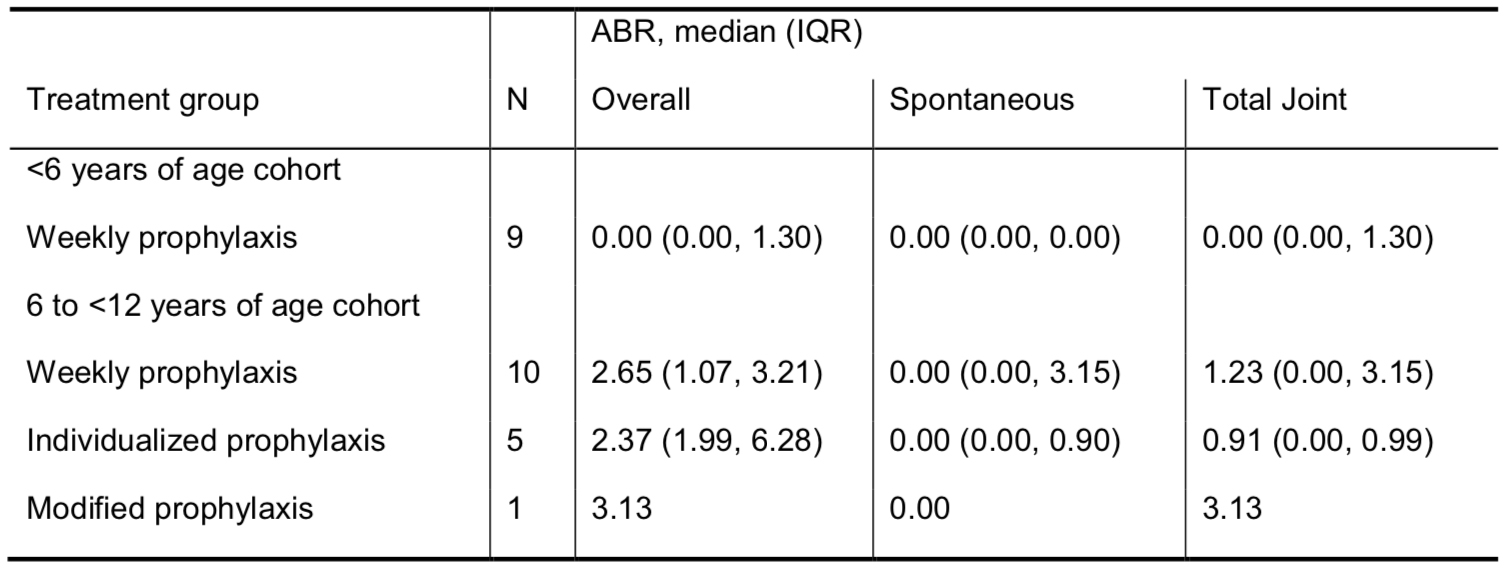
At the time of the interim data cut (17 October 2014), 23 subjects had completed Kids B-LONG; all enrolled in B-YOND (<6 yrs of age cohort, n=9; 6 to <12 yrs of age cohort, n=14). As of the interim data cut, 2 subjects had completed and 21 subjects continued in B-YOND (median time on study: 47.7 weeks). From the start of Kids B-LONG to the B-YOND interim data cut, the median time on rFIXFc was 95.3 weeks, with a median of 94 cumulative rFIXFc EDs. All subjects were on weekly prophylaxis in Kids B-LONG; 5 subjects changed treatment groups at the start of or during B-YOND. In the weekly prophylaxis group, the median (IQR) average weekly prophylactic dose was 64 (52, 66) IU/kg and 63 (59, 64) IU/kg in the <6 yrs and 6 to <12 yrs of age cohorts, respectively. The median (IQR) dosing interval among subjects on individualized prophylaxis was 10 (10, 11) days. As of the interim data cut, no inhibitors were observed, there were no reports of anaphylaxis or serious hypersensitivity reactions associated with rFIXFc, and no thrombotic events. Adverse events were typical of the pediatric hemophilia B population; no subject discontinued the study due to an adverse event. Median ABRs were low in both age cohorts (Table). Overall, 95% of bleeding episodes were controlled with 1 or 2 infusions.

Conclusions:

Interim data in children with severe hemophilia B participating in B-YOND confirm the long-term safety of rFIXFc and the maintenance of a low ABR with extended-interval prophylactic dosing.

Table. Interim results of the B-YOND study